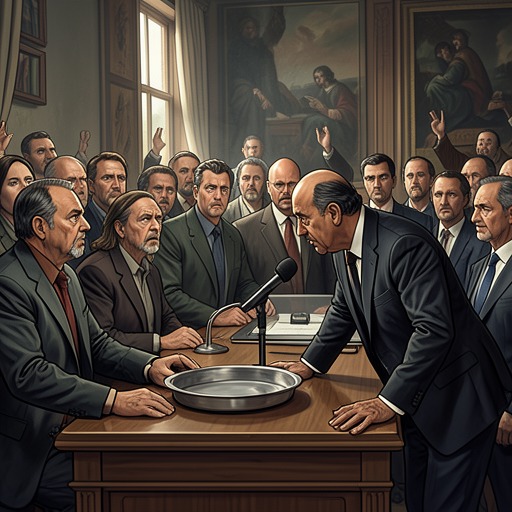
Bessie Mears’s body presented at the inquest
Native SonThe presentation of Bessie Mears’s body at Mary Dalton’s inquest turns a proceeding about Mary’s death into a public confrontation over whose death will count, and how. The coroner makes Bessie’s body part of the case against Bigger Thomas; Max objects that the display serves to stir mob violence rather than establish what happened to Mary. The episode exposes the unequal treatment of the two victims even as it advances the official case against Bigger.
The body presented as evidence
The deputy coroner announced that Bessie’s body and the testimony of police officers and doctors about her death would be offered in evidence. Max protested that exhibiting her body served no proper purpose and risked inciting the crowd. The coroner answered that the evidence would help the jury determine how Mary Dalton had died, arguing that both women had been killed by Bigger. His justification linked the deaths in the courtroom, but also made Bessie’s death a means of strengthening the case concerning Mary. The jury’s attention was directed toward the charge against Bigger, while Max’s objection challenged the use of Bessie’s body as a public instrument in that case.
The unequal recognition of the two deaths
Bigger had forgotten Bessie during the inquest into Mary’s death, not because he regarded Bessie’s life as less important, but because Mary’s death had become the source of his greatest fear: he understood that, as a Black man accused of killing a white woman, he faced consequences beyond the charge itself. The appearance of Bessie’s body forced him to confront a second death that the proceedings had not previously acknowledged. He recognized that presenting her as evidence against him could make him seem more monstrous to the white audience, intensify its hostility, and help secure his destruction.
Bigger also understood the imbalance in the coroner’s reasoning. Bessie’s death was made relevant chiefly because the prosecution could connect it to Mary’s, while the killing of a Black woman by a Black man had not, in itself, drawn comparable public attention. In his understanding, white society treated crime against Black people differently from crime against white people: Bessie could be entered into the proceedings as proof, while Mary’s death supplied the case’s central urgency. The two women were thus joined in the courtroom but not granted equal recognition as victims.
The display changed Bigger’s relation to Bessie in a painful way. Although he had killed her, he now felt a deeper sympathy for her and believed she would have resented the use of her body for the case against him. His response recalls the exhaustion and frustration she had described after long hours working in white households: the feeling of being directed by others until independent thought and feeling seemed impossible. At the inquest, that condition appeared to Bigger not as something ended by her death but as a power continuing to act upon her, turning her into an instrument in a proceeding centered on Mary.
The inquest's finding and immediate effect
When the coroner uncovered Bessie’s body, Bigger flinched and could not bring himself to look steadily at her. He remained motionless through the uproar, trying to shut out both the sight and the voices around him. The scene made the inquest’s use of Bessie as evidence immediate and personal: the proceeding did not merely connect her death to Mary Dalton’s, but placed Bigger before the public accusation while he struggled to endure the display.
After the jury briefly withdrew, the coroner read its finding on Mary’s death. The jurors determined that Mary had died by suffocation and strangulation in the bedroom of the Dalton residence at 4605 Drexel Boulevard, and classified the death as murder committed by Bigger during a criminal rape. They recommended that he be held for the Grand Jury on a murder charge, pending release through due process. The finding was an inquest determination and referral, not yet a trial verdict or sentence.
Bigger understood the recommendation as meaning that he would remain in jail until trial and execution. When the coroner finished reading, he seemed to return to awareness only gradually, and Max took hold of his arm. The presentation of Bessie’s body thus ended not with a judgment on her death in its own right, but with an official finding about Mary and a recommendation that carried Bigger from the inquest toward criminal prosecution.
Bessie's silenced protest
Before her death, Bessie had asked Bigger to stop, but he ignored her. At the inquest, her earlier refusal is not heard as testimony: the coroner presents her body and medical evidence, while the argument centers on what her death can establish about Mary Dalton's. The contrast makes the proceeding's imbalance especially stark. Bessie had spoken against what Bigger was doing, yet in court she appears chiefly through evidence controlled by others; the recognition that she might resent this use of her body comes only through Bigger's belated understanding.